MacroBBC BusinessJul 17, 2026· 1 min read
China's Moonshot AI Unveils Kimi K3, Challenging US AI Dominance
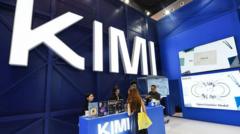
Chinese AI company Moonshot AI has launched Kimi K3, a new large AI model it claims can compete with leading US firms OpenAI and Anthropic. This development signals China's increasing capabilities in artificial intelligence and intensifies global competition in the sector.
Chinese AI firm Moonshot AI has introduced Kimi K3, a new large artificial intelligence model that the company asserts rivals offerings from leading American counterparts, OpenAI and Anthropic. This development signifies a notable advancement within China's domestic AI landscape and intensifies the global competition in the rapidly expanding artificial intelligence sector.
The unveiling of Kimi K3 underscores China's strategic imperative to cultivate indigenous technological capabilities and reduce reliance on foreign AI infrastructure. The country has heavily invested in AI research and development, aiming to establish itself as a global leader in the field. The introduction of a model with claimed capabilities comparable to those of OpenAI's and Anthropic's flagship products suggests a potential narrowing of the technological gap, at least in certain domains of large language models.
Economically, the emergence of strong Chinese AI models like Kimi K3 could lead to several implications. Domestically, it could stimulate further investment and innovation within China's technology ecosystem, fostering new applications and services powered by advanced AI. For global markets, increased competition among AI developers could accelerate the pace of innovation, potentially driving down costs for AI services and expanding their accessibility across various industries. This competitive pressure might also prompt US firms to redouble their efforts in R&D to maintain their leadership position.
Furthermore, the geopolitical dimension of AI development cannot be overlooked. The race for AI supremacy has implications for national security, economic competitiveness, and technological influence. A strong domestic AI industry empowers China with greater control over its data processing and AI applications, potentially impacting international data governance and technology transfer policies. The performance and adoption of Kimi K3 in both the Chinese and potentially broader Asian markets will be closely watched as a gauge of China's progress in this critical technological frontier.
Analyst's Take
While the immediate market impact might seem confined to the tech sector, this announcement could subtly influence venture capital flows, potentially diverting investment towards non-US AI startups perceived as having viable scaling pathways. Furthermore, it foreshadows an accelerated 'AI localization' trend, particularly in Asia, where governments and enterprises may increasingly favor domestic or regionally developed models over US alternatives for data sovereignty and geopolitical reasons, creating new market fragmentation.

